“Be confused, it’s where you begin to learn new things. Be broken, it’s where you begin to heal. Be frustrated, it’s where you begin to make more authentic decisions. Be sad, because if we are brave enough we can hear our heart’s wisdom through it.”
“Be whatever you are right now. No more hiding. You are worthy always.”
S.C. Lourie
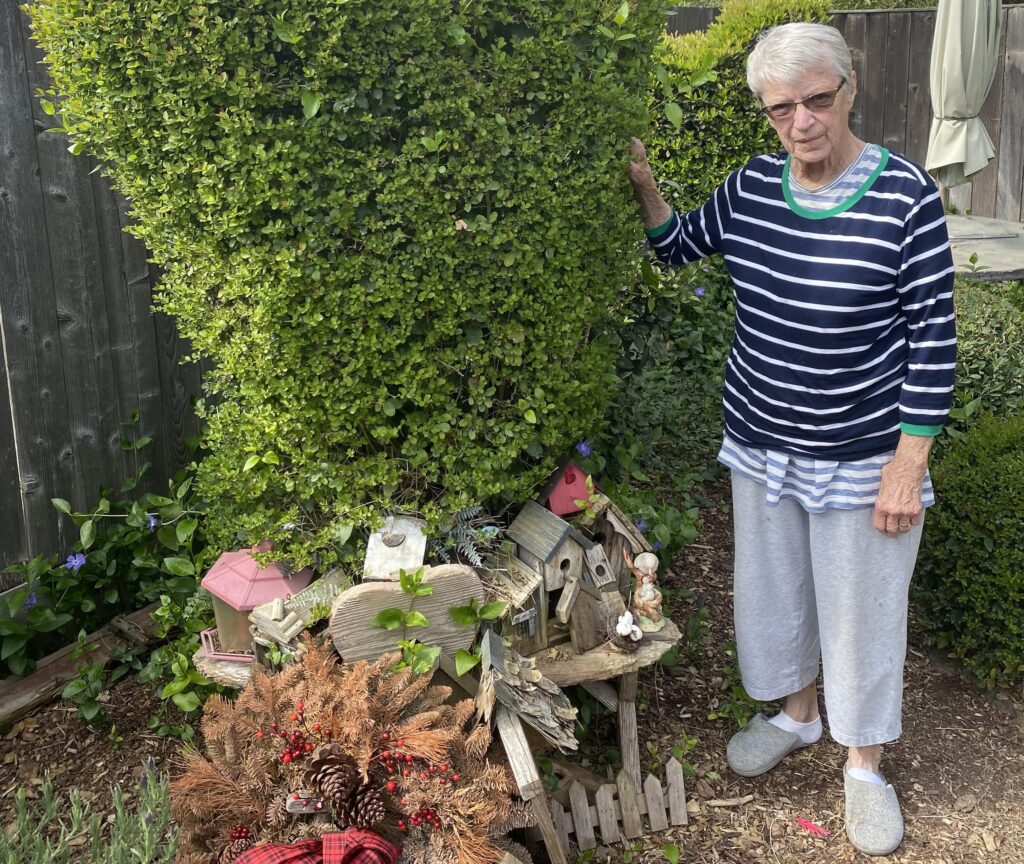
Mom’s Not Hiding Anymore …
This was a pivot point; mom’s exhale about her memory loss, recall struggles, forgetting loved one’s names, and other such problems were her first steps toward ‘Dementia’s Freedom’. The moment mom unlocked herself from ‘Dementia’s Secrets’ we could begin to accelerate the ability to seek care, provide necessary support, and speak truth and understanding. Mom’s humility and transparency gave her peace with family & friends how having a window into her world to recognize her pains, fears, and new behaviors.
With the acceptance from mom and Joe I began making doctor appointments for mom, recording all Kaiser (mom) and VA (Joe) information, and documenting all medications. I began by requesting assessments and imaging necessary for mom’s back pain and memory concerns.
Spinal Stenosis was not yet known, but mom freely began to express the pain that emanated throughout her lower back, down her right leg. I spotteded mom frequently in search of large blue pain pills purchased from Costco that may have helped her sleep a little better. She became highly desiring of these pills, especially in the evening. Possibly an early indication of addiction.
Mom would seek these magic pills as if no one was observing her quest, sputtering around the kitchen not remembering what she was foraging for while swinging cupboards and drawers open. Mom was on the hunt for those elusive blue pills to subdue the overwhelming racket in her head, pause the pain in her back, and give her permission to slip into an unconscious state for the night free from inner mental torment.
Becoming aware that Joe was not attentive nor willing to understand mom’s challenges, I recognized the need to ensure mom got her prescribed meds and no more. This started with phone call reminders which quickly led to the need to physically check-in and make sure mom’s meds were taken and blue pills were not located.
Mom’s attempts to escape her mental prison revealed life’s burdens pressing down on her. I had to pay attention and zero in on it. It wasn’t like mom said, “Please take my car keys,” or, “Be sure to answer the phone because it spikes my anxiety.” No no, not at all.
After reading about dementia and speaking with social workers, in-home care takers, memory care personnel, and especially ‘A Place for Mom’ I became aware that mom was feeling overwhelmed by life’s normal routines because she was not ‘normal’. She was drifting, fluttering away from life’s social norms. She needed to be relieved of unnecessary worries and responsibilities.
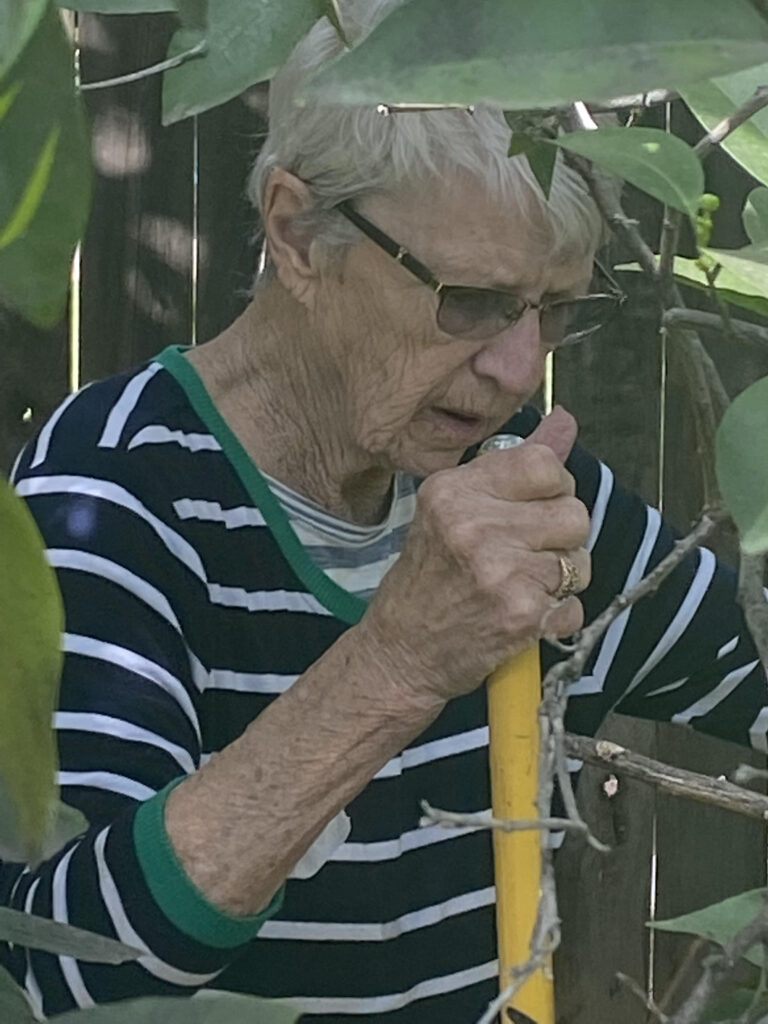
The first thing to go was yard work. She would comment about the relief she felt being releasing from this responsibility. Ironically, the fact she accepted the relief spoke volumes in itself because for years she refused any assistance. Hardworking and stubborn little Sheila 🥲. It triggered in me a pattern. I sought to find things that were overcoming her and eliminate them as soon as possible.
During the month of January as I was starting to spend more time with mom, I recognized a repeated remark she would make, “Out there on Bullard (busy street just two doors from her home),” she’d say, “I would stop in the middle of the road and walk as those cars just fly by. I’d feel better opening the door of my car in the middle of the street and start walking instead of driving in that. Tsk tsk tsk. They go so fast and these young kids on their phones. Ah, forget it.”
This led to a conversation about how I gave up driving due to the liability of having an accident (being legally blind) and the freedom that comes from giving it up. Willingly she let go of her keys. The anxiety that came from simply pondering the thought of driving was lifted. Mom’s independence which she coveted took a distant back seat to the emotional stress of traversing traffic and streetlights. This is how debilitating and overwhelming her fear of being behind the wheel became.
More unwillingly Joe had her driving in a parking lot, practicing, when I was not around though I told him she is frightened, anxious, and becoming a danger on the road. This awareness came to fruition during a memory assessment with Doctor Bains, mom’s new memory doctor. Joe was in the waiting room while mom and I were in with the doctor who was evaluating mom’s cognition. During the session mom mentioned that Joe was having her drive in a parking lot though she wished he didn’t.
I was filled with a couple emotions, feeling ticked at the thought that Joe might be putting mom in danger. Also, I was aware mom could be speaking from a point of concern and fear, possibly a little delusional. So, at the conclusion of the medical consult I asked Dr. Bains to discuss the risk and encumbrance with mom behind the wheel.
Doctor was more than willing.
I retrieved Joe. He sat facing the lady in the white cloak, directly questioned if he was having his wife practice driving in a parking lot. He glanced to his right looking at me, bowed his head like a child who just stole three chocolate chip cookies from a cookie jar, and said, “Yes.”

She continued, “Do you realize that your wife has dementia?”
I interrupted, “Doctor, please ask Joe if he knows what dementia is and if he doesn’t, please explain it to him.”
“Sure,” she said. ‘Joe, do you know what dementia is?”
“No, I don’t,” Joe said.
“Dementia is a memory disorder. Your wife’s brain is affected, reasoning is impaired resulting in an interference in daily life activities like driving. Gwen ls overwhelmed. When you place her behind the wheel of a car you are putting her in danger. In fact, once we have a CT scan on her brain and we determine officially she has dementia I will indicate in her report that legally she should never be driving, ever be driving again.”
“Mom is like me, Joe,” I said. “If she drives and gets in an accident that is NOT her fault she will be at fault because knowingly she went behind the wheel of a car having dementia. Joe, if you have her drive, you could be criminally charged because you are putting mom in harm’s way knowing she is at high risk. You cannot have her get behind the wheel. Mom will never drive again after this day.”
Next thing I noticed was the phone. Mom avoided the phone like a plague, not wanting anyone handing her the phone while feeling bewildered, uncomfortable, and confused. I reassured her saying, “You never have to answer the phone again. Let Joe or me answer it. If we are not around just let it ring and go to voicemail. Nothing is that important that you must pick up.”
This gave her further relief, saying, “Oh, that is good. Yes, nothing is that important.”
I cancelled her cell phone which she only used when volunteering at the Fresno Chaffee Zoo. One more worry was removed not to mention the monthly charge. Medication was discussed each day, reassuring mom that she did not have to remember to take anymore pills. I would be sure to keep track and, as for doctor appointments, I was scheduling all of them.
I would arrange for travel and provide her identification at every counter so she would not need to fish through her purse in a panic and fluster. All she had to do was be kind, look pretty, and stay with me or anyone else who would be caring for her. No worries.
I began to stay the night through each week. Cheryl or Perry came from out of town on weekends to relieve me, spend time with mom and help in their way. Together we monitored medication and processed all the changes. It was like supply and demand. As problems became less in supply the demand (burden) of responsibility waned. The freedom dementia brought was beginning to flower, a silver lining within a scrambled mind that was not full bloom, but buds were forming.
Spring was approaching.
As many problems were slowly being stripped away one began to hang on a branch like a cluster of peaches bending a limb near the ground. Money. Joe often spoke about saving money to a fault, a penny pincher if ever I knew one. For example, shopping one day at Wal Mart we were about to put an ice cream carton in the basket when Joe said it was too expensive. It literally took well over three minutes for him to locate the ice cream with the lowest price. The price difference was .25 cents. I also value a thrifty mindset when shopping, but that’s a long time for mom to wait patiently for a shiny quarter without wandering off down some aisle.
This monetary concern became an indelible imprint on mom. She began fretting that they did not have enough savings. She would think Joe was keeping the funds for himself and not willing to share. She was deluded at times thinking an old family friend, Jim O’Brien, was trying to take their assets. She saw Joe’s statements strewn over the dining room and kitchen tables thinking that these old statements were bills that needed to be paid.
Each day for a few weeks she would obsess over the old statements spread over the tabletops. The wooden kitchen tabletop was not seen for over 30 years (with the exception of Thanksgiving and Christmas dinners) due to him dominating the table with bills. Recently, the dining room table was overtaken, covered with tax information and age-old bills that were already paid.
Joe and mom were frugal, always paying their bills on time or early, but his method was a visual distraction for mom in the front room, a helter-skelter of papers strewn throughout rooms. Joe could care less and was in no hurry to clean it up. Mom, well, she could not stop obsessing, her mind falsely creating scenarios about debt and not receiving her fair share.
Joe for weeks refused to clear the mess. He didn’t see the big deal though multiple times it was explained to him by me that mom was triggered by the clutter. Like I shared, Joe was an ostrich. He either slept in the back room or was sitting at the kitchen table with his right leg hoisted on the tabletop, lost in his own thoughts staring into space, rarely ever checking on mom. To his defense he was on seven different medications and his blood pressure was sky high. He claimed to not have slept through the night for over six years, fully cognitive of his grief, not mom’s.
Care and attention were in abundance for Joe if he needed it. But his disregard of mom’s needs and unwillingness to learn about her dementia symptoms and treatment caused a boat load of challenges. One morning mom was highly agitated over the dining room table not being cleared and her delusion about money issues peaked. Her good friend and nun, Sister Cellie, was arriving later that day. In her mind the dining room table needed to be cleared for her guest causing the table to be a point of repetitive mental recycling.
I approached Joe and shared what needed to be done. Mom had been waiting weeks to have the dining room table cleared. He dismissed mom, then me. So, I calmly and demonstrably let him know that either he or I would remove the papers because it is making mom paranoid.
For about thirty minutes Joe shuffled around the dining room table. He moved a piece of paper from one pile to the next. Then, he sat back down in his chair in the kitchen swinging his right leg upon the table, head down like practically every day the past many many years.
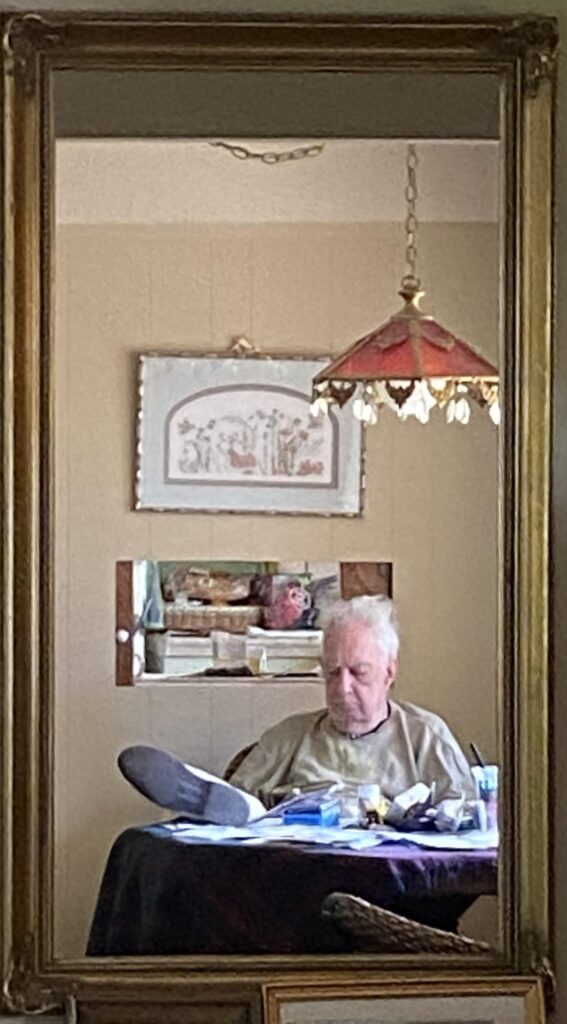
Nothing was being cleared, the polar opposite of mom’s desires as she wanted the table presentable before her guest arrived. Joe acted like he didn’t care but as I reflect back the thought of organizing his clutter likely boggled his mind and overwhelming his senses.
I took initiative to strip the dining room table of all the papers, sorting them into two different piles as Joe demanded. When finished, I told him he would not put one more piece of paper on that dining room table (the kitchen table was his to do as he wished).
Reluctantly he relented., tired and sad.
Note: The next post is ‘Dementia Observed in Mom, Part 1 of 2: Good Morning Mom …’ welcome to a new reality.
Take care, my friend 👍
